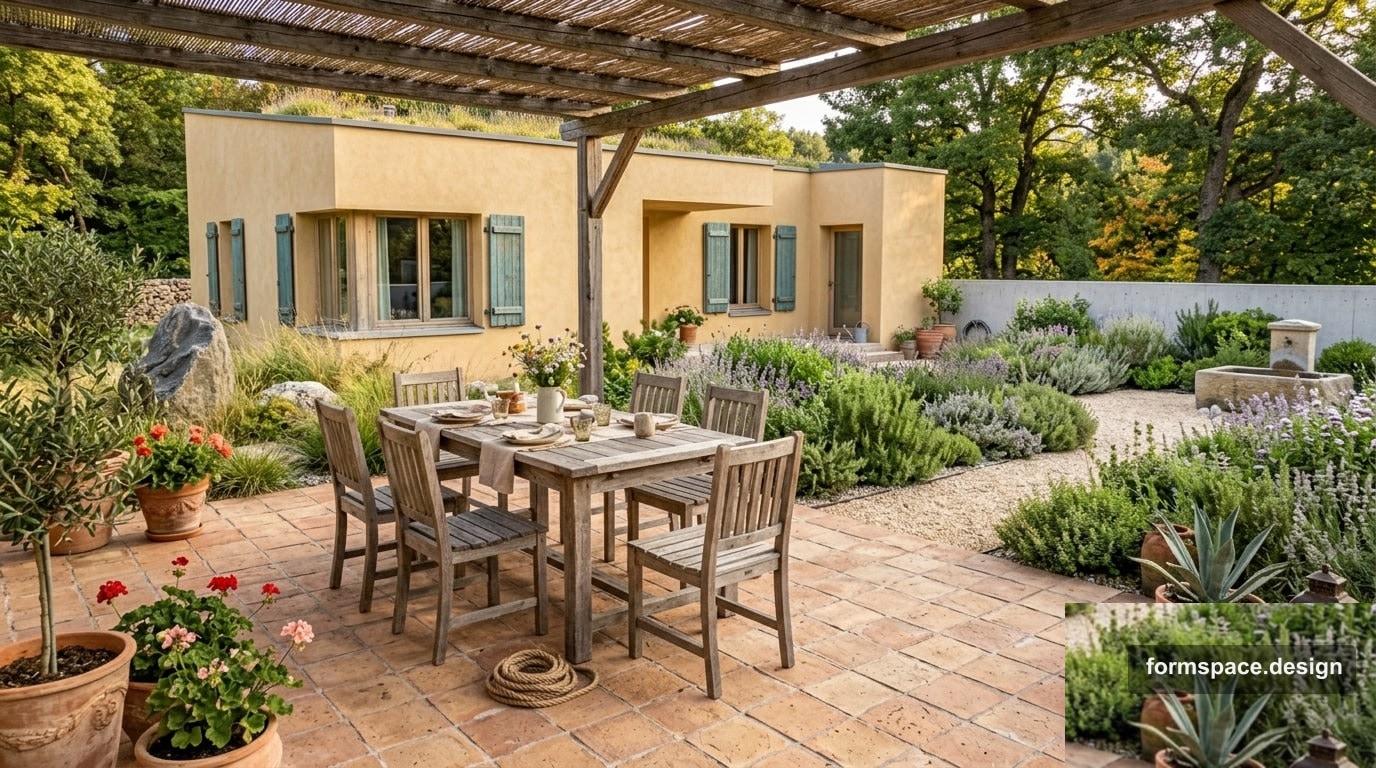
Gîte saisonnier de style provençal : schéma des zones et matériaux
La Provence pour un chalet de week-end : graviers, gazon, terrasse chaleureuse, espaces simplifiés. Spécification technique pour formspace.design.
Réponse courte : La Provence saisonnière est une terrasse chaleureuse, du gravier léger, des herbes répétées, un potager compact et une palette douce sans roseraie complexe. Il convient pour un chalet de week-end, si vous ne transformez pas le site en une collection de plantes capricieuses.
L'idée d'un tel jardin n'est pas de copier littéralement le sud, mais de créer une sensation de lumière sèche, de textures simples et de détente. Il vaut mieux créer une terrasse confortable, deux rubans de plantations parfumées et un chemin dégagé vers le jardin que dix petits parterres de fleurs que personne n'a le temps de désherber. Pour les solutions voisines, regardez Provence sur 6 acres, minimalisme saisonnier et espaces barbecue, piscines et terrasses.
Matériaux et zones
Palette principale : graviers clairs, carrelage chaleureux, pots de fleurs en terre cuite, bois, teinte calcaire de la pierre, paillis sous herbes. À partir de plantes, prenez des analogues durables de la lavande, de la sauge, de l'herbe à chat, des céréales, de la spirée et des parterres d'épices. Ce qui est important n'est pas le nombre d'espèces, mais la répétition : la même bande d'herbe près du chemin, près de la terrasse et à côté du jardin relie le site.
| N° | Zone | ~% | Que mettre en gage |
|---|---|---|---|
| 1 | Entrée | 12 | Gravier léger et stationnement facile |
| 2 | Terrasse | 18 | Carrelage chaleureux ou bois, table, abat-jour |
| 3 | Rubans d'herbe | 22 | Plantes répétées, pas un mélange de tout |
| 4 | Cour extérieure | 24 | Pelouse de prairie ou simple clairière |
| 5 | Potager et verdure | 14 | Près de l'eau, dans des massifs soignés |
| 6 | Bloc Hozblok | 10 | Derrière un treillis, des buissons ou un écran |
Comment construire dans formspace.design
En 1,1 écrire : « gîte saisonnier, Provence, graviers clairs, herbes aromatiques, terrasse chaleureuse, potager compact ». À 1,2, chargez un arrière-plan pour tenir compte de la maison, des ombres, de l'allée et des arbres existants. Dans 1,3, définissez les limites de la zone et l'échelle. Dans 1,4, ajoutez les anciens objets restants. Dans 1,5, commencez par tracer de grandes surfaces sans dessiner chaque parterre de fleurs. À 1,6, ajoutez des couvertures, des bandes de gazon, des plates-bandes et des écrans. À 1,7, vérifiez les zones de gravier, de tuiles, de gazon et les longueurs de bordure.
Erreurs fréquentes
- Créez une roseraie sans arrosage ni entretien réguliers.
- Choisissez de la pierre concassée foncée : elle surchauffe et alourdit visuellement une petite maison.
- Dispersez des pots et de la lavande dans toute la zone sans motif répétitif.
- Installez une piscine sans mode hiver et sans espace pour les équipements.
- Tracez des sentiers étroits dans l'herbe : après la pluie, ils deviennent gênants.
- Oubliez la zone utilitaire, et placez ensuite les fûts et le matériel sur la terrasse principale.
FAQ
Combien de plantes suffisent ?
Pour 6 à 10 acres, 5 à 7 éléments de base suffisent : plusieurs herbes aromatiques, un ou deux arbustes, des céréales et des pots de fleurs de saison.
Est-il possible de ne faire quasiment pas de pelouse ?
Oui. Laissez une petite clairière ou un fragment de prairie et convertissez le reste en gravier et en bandes de plantation.
Où placer un potager ?
Plus près de l'eau et de la sortie de cuisine, mais pas au centre de l'axe de vue. Il peut être recouvert d'un treillis.
Le style est-il adapté aux climats froids ?
Il conviendra si vous choisissez des plantes résistantes selon la zone et véhiculez la Provence avec des matières, de la couleur et de la répétition, et non avec de l'exotisme.
Qu'est-ce qui est considéré comme l'accent principal ?
Terrasse. Dans une datcha saisonnière, c'est elle qui rassemble le petit-déjeuner, le thé du soir, les invités et une vue sur le jardin.
Résumé
La Provence saisonnière doit être douce, mais pratique : des revêtements chauds, une répétition d'herbes, un potager simple et un minimum de détails capricieux. Commencez par un plan dans formspace.design : créer un projet, puis vérifiez la nomenclature avant d'acheter.
Date de publication :

Volodymyr Vybornyi
Paysagiste, fondateur de https://formspace.design/
Écrit sur le design paysager, le business et les outils modernes de conception paysagère assistée par ordinateur, y compris l’IA.