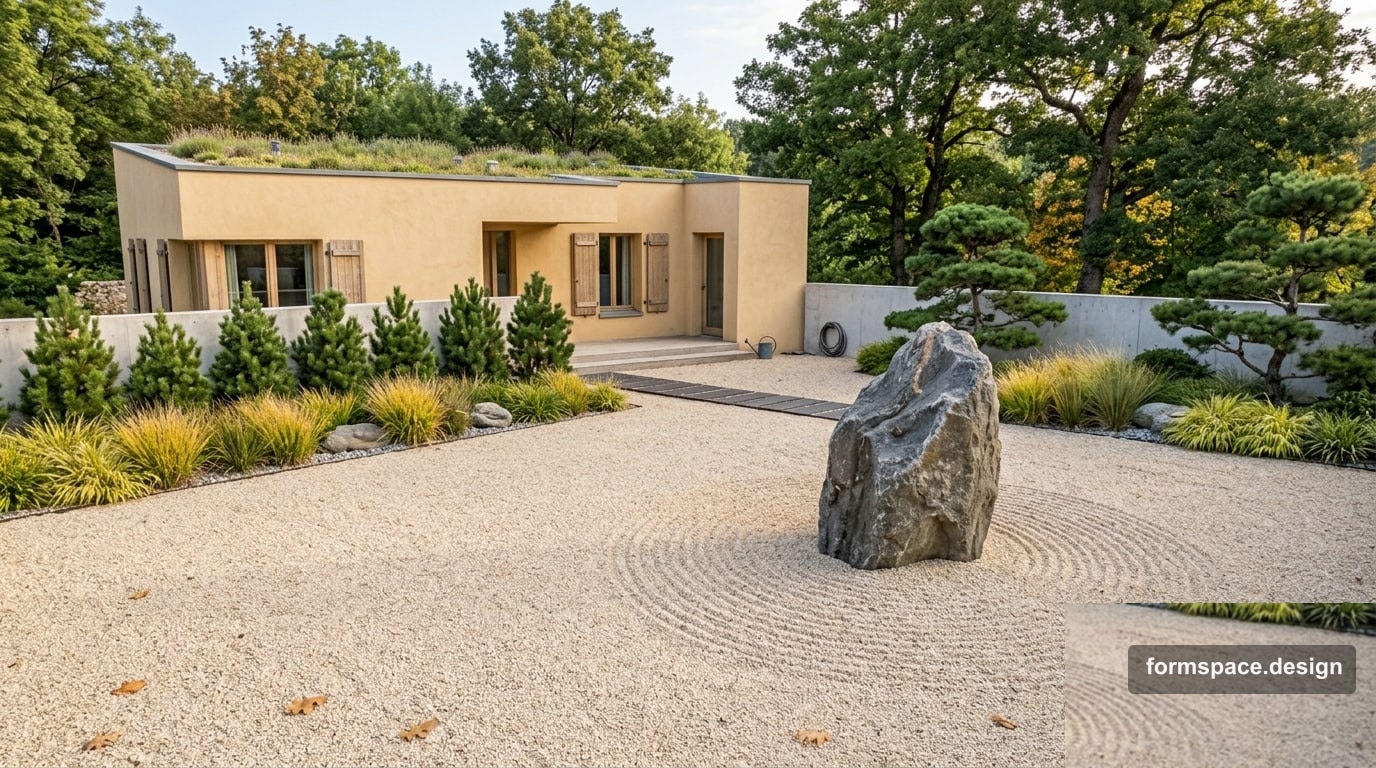
Saisonales Ferienhaus im japanischen Stil: wenige Objekte, viel Ruhe
Japanisches Motiv für ein Wochenendhaus: Kies, ein Akzent, vereinfachte Zonen. Technische Spezifikation für formspace.design.
Kurze Antwort: Ein saisonales Sommerhaus im „japanischen Stil“ ist eine Kiesfläche, ein ausdrucksstarker Akzent, ruhige Pflanzlinien und kein großer Rasen. Ein solcher Bereich versucht nicht, wie ein Park auszusehen: Er gibt der Stille Raum und erfordert keine heldenhafte Pflege nach jeder Woche Abwesenheit.
Die Idee ist einfach: Lassen Sie 2-3 starke Lösungen übrig und entfernen Sie alles, was ständige Aufmerksamkeit erfordert. Der visuelle Mittelpunkt könnte ein Felsen, eine niedrige Laterne, eine Kiefer in einem Behälter oder eine Gräsergruppe sein. Der Rest dient als Hintergrund: eine saubere Terrasse, heller Kies, Schatten vom Haus, schmale Pflanzstreifen. Wenn Sie einen Vergleich mit anderen Szenarien wünschen, schauen Sie sich Japanischer Garten 6 Acres, Ferienhaus mit minimalem Wartungsaufwand und saisonale Provence an.
Materialien und Zonen
Verwenden Sie hellen oder graubeigen Kies, große Platten, Holz für Terrassendielen, Rinde oder mineralischen Mulch unter der Bepflanzung. Es ist besser, Pflanzen zu wiederholen: 2-3 Arten von Nadelbäumen, Gräsern, Bodendecker, ein saisonaler Akzent am Eingang. Fügen Sie Wasser, komplexe Brücken und leuchtend rotes Dekor nur hinzu, wenn es wirklich nötig ist, und nicht „weil es japanischer Stil ist“.
| Nein. | Zone | ~% | Was zu verpfänden ist |
|---|---|---|---|
| 1 | Eintrag | 10 | Belagswechsel, einfache Linie zum Haus |
| 2 | Terrasse | 16 | Sauberes Flugzeug ohne unnötige Möbel |
| 3 | Kiesfeld | 32 | Ruhiger Haupthof |
| 4 | Lineare Landungen | 20 | Nadelbäume, Getreide, Mulch |
| 5 | Akzent | 12 | Stein, Laterne oder ein Baum |
| 6 | Versorgungsblock und Minigarten | 10 | Mit Bildschirm oder Live-Streifen ausblenden |
So bauen Sie formspace.design ein
Beschreiben Sie in 1,1 den Modus: „Saisonhäuschen, japanisches Motiv, wartungsarm, Kies, ein Akzent.“ Laden Sie in 1,2 einen Plan oder ein Foto des Geländes hoch, um das Haus, den Zaun, die Schatten und den Eingang zu sehen. Legen Sie in 1,3 die Grenzen und den Maßstab fest. Markieren Sie in 1,4 vorhandene Objekte: Haus, Brunnen, alte Bäume, Nebengebäude. Bei 1,5 große Flächen ohne Details anlegen. Fügen Sie in 1,6 Beläge, Bepflanzungen und Akzente als neue Objekte hinzu. Überprüfen Sie bei 1,7 die Schotterflächen, Weglängen und Materialliste.
Häufige Fehler
- Sammeln Sie ein „Souvenir-Set“: eine Laterne, eine Brücke, eine Pagode, ein rotes Tor und einen Teich auf sechs Hektar.
- Legen Sie neben dem Kies einen großen Rasen an: Nach seltenen Besuchen wird dieser schnell zur Hauptarbeitsquelle.
- Platzieren Sie den Kinder- oder Sportbereich direkt im Kiesfeld; Hierfür ist es besser, eine Familienvorlage zu wählen.
- Verwenden Sie zu feinen Kies ohne Rand: Er verteilt sich auf Wegen und Terrassen.
- Verteilen Sie Akzente im gesamten Bereich statt auf einen ruhigen Punkt.
FAQ
Ist der Stil für 6 Hektar geeignet?
Ja, noch besser: Eine kleine Fläche profitiert von einer begrenzten Palette und leeren Flächen.
Ist es möglich, den Garten zu erhalten?
Es ist möglich, aber kompakt und separat: hinter der Leinwand, neben dem Wasser und ohne Konflikt mit dem Hauptsichtbereich.
Was tun mit einem alten Apfelbaum?
Belassen Sie es als Schatten- oder Hintergrundvolumen, wenn es in Ordnung ist. Fügen Sie in formspace.design einen Baum zu 1,4 hinzu und bauen Sie neue Pflanzungen um ihn herum.
Brauchen Sie einen Teich?
Nicht unbedingt. In einer saisonalen Datscha trägt Wasser oft zur Erhaltung bei; Ein trockenes „Meer“ aus Kies ist sicherer.
Wie kann man verstehen, dass bereits genügend Objekte vorhanden sind?
Wenn von der Terrasse aus ein Hauptakzent sichtbar ist, ein sauberer Belag und eine Wiederholung der Pflanzen, ist es besser, weiter aufzuhören.
Zusammenfassung
Das japanische Drehbuch für einen saisonalen Garten basiert auf Innehalten, Maßstab und Disziplin. Beginnen Sie mit einem einfachen Plan in formspace.design: Projekt erstellen, überprüfen Sie die Zonen und kaufen Sie keine Materialien, bis die Flächen berechnet sind.
Veröffentlicht:

Volodymyr Vybornyi
Landschaftsdesigner, Gründer von https://formspace.design/
Schreibt über Landschaftsdesign, Business und moderne computergestützte Planungswerkzeuge für Landschaften – einschließlich KI.