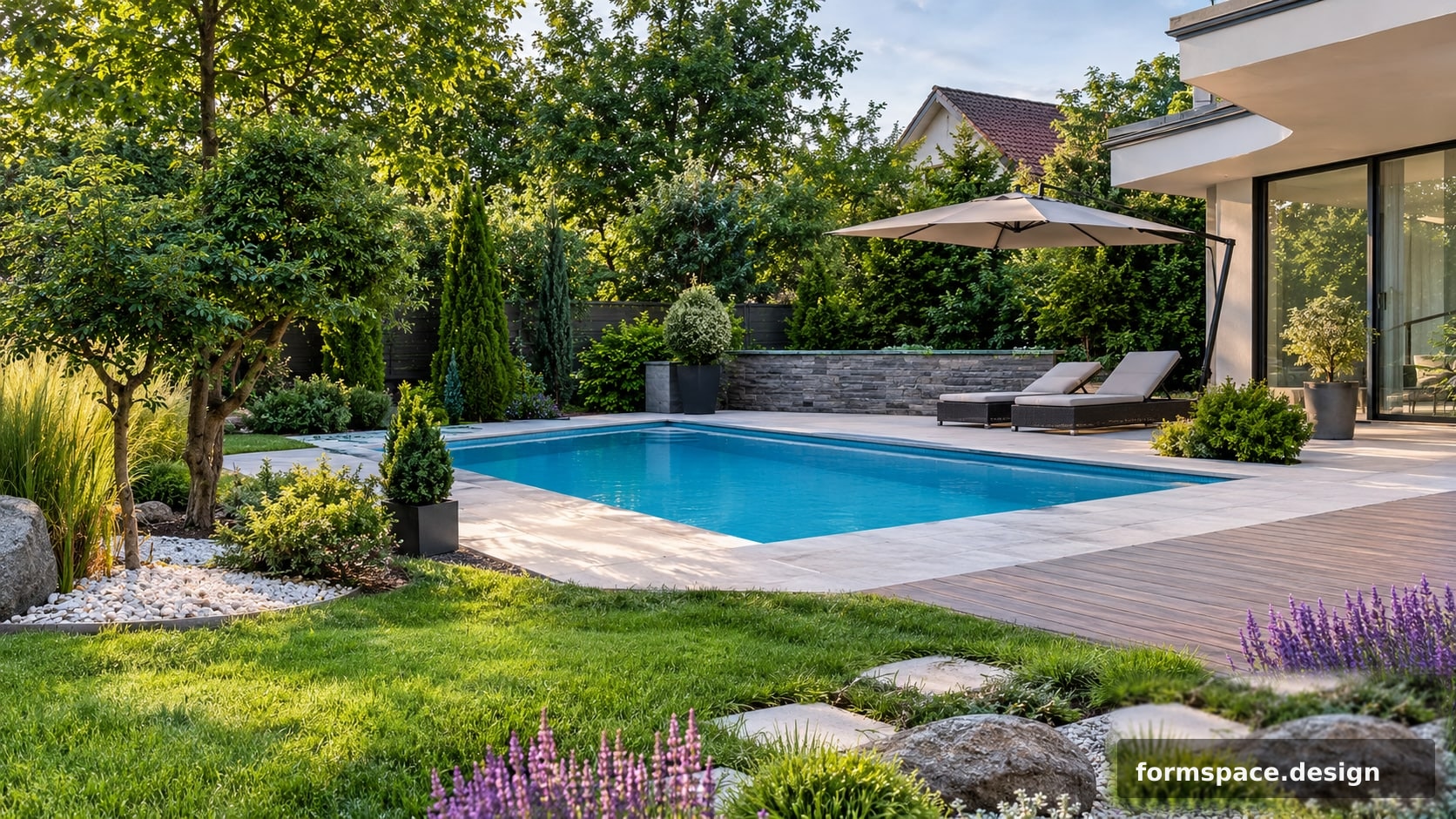
Why the Pool Didn't Fit into the Landscape: Main Mistakes
Learn how to avoid common mistakes when integrating a swimming pool into your landscape. Proper zoning, style selection, and material choices are key to harmony.
Often, plot owners, dreaming of their own pool, focus only on its basin and technical aspects, forgetting that a pool is not just an object, but an entire zone that must harmoniously fit into the overall landscape design. As a result, instead of a cozy oasis, a foreign element appears on the plot, disrupting the aesthetics and functionality of the space. The reasons for such dissonance lie in insufficient project development and ignoring basic principles of landscape planning.
Ignoring the Overall Landscape Plan
The most common mistake is deciding to build a pool spontaneously, without a preliminary comprehensive analysis of the entire plot. A pool cannot exist on its own; it must become part of a unified composition that considers the terrain, existing buildings, paths, recreation areas, and landscaping. If there is no clear understanding of how the pool will interact with the house, terrace, sauna, or children's playground, it will inevitably look detached from the context. It is important to envision the entire plot from the outset and only then integrate new elements into it.
Incorrect Placement and Zoning
The location of the pool is critically important. Mistakes here can be fatal for visual perception and ease of use. For example, placing a pool in the shade of tall trees will not only make the water cold but also lead to constant contamination with leaves, which will worsen the appearance and require intensified cleaning. Placing it too close to the plot boundary or the house can create a feeling of cramped space. The ideal place for a pool is a sunny, wind-protected spot, conveniently located relative to the house and the main recreation area. There must be a functional zone around the pool – for example, a terrace at least 1.5–2 meters wide for sun loungers and safe movement, as well as a technical zone for equipment, which should be hidden from view but easily accessible for maintenance.
Dissonance with the House and Garden Style
Every plot has its unique style, be it classical, modern, rustic, or Mediterranean. The pool, its shape, finishing materials, and the surrounding space must correspond to this style. For example, a rectangular pool with clear lines and a minimalist environment would be out of place in a country-style garden with an abundance of flower beds and natural materials. Conversely, a pool of irregular, natural shape would be lost against the backdrop of a strict modern house. This aspect is often underestimated, leading to visual conflict and a sense of foreignness. You can read more about landscape design styles in our article: How to choose a landscape design style for your plot.
Mistakes in Material and Paving Selection
Materials used for the basin lining, coping, and adjacent terrace play a huge role in the pool's integration. Bright blue tiles can look too flashy against calm greenery, and a slippery surface around the pool can be dangerous and impractical. It is important to choose materials that harmonize with the overall color scheme and textures already present on the plot. Natural stone, composite decking, or non-slip porcelain stoneware, chosen to match the house facade or garden path, will help create a unified ensemble. Avoid overly contrasting or cheap-looking materials that can detract from the overall appearance.
Insufficient Landscaping Around the Pool
A pool surrounded by bare tiles or concrete will always look artificial and unwelcoming. Plants soften harsh lines, create shade, improve the microclimate, and add naturalness. However, the choice of plants must be well-thought-out. Avoid heavily shedding trees and shrubs to prevent water contamination. Opt for moisture-loving but not overly demanding plants that can withstand splashes of chlorinated water. Ornamental grasses, hostas, ferns, as well as conifers or shrubs with dense foliage can be an excellent solution. It is important to create multi-level landscaping so that the pool does not look flat and isolated. For harmonious plot zoning, we recommend the article: How to properly zone a plot: principles and ideas.
Poorly Thought-Out Lighting
Lighting for the pool and the adjacent area is not only a matter of safety but also an important design element, especially in the evening. The absence or incorrect placement of luminaires can make the pool area dark and uninviting. Underwater lighting, path lighting, decorative lanterns, and spotlights directed at plants create atmosphere and emphasize the beauty of the landscape. It is important to consider lighting scenarios: bright light for active use and soft, diffused light for evening relaxation. Overly bright or direct lighting can spoil the entire impression.
How to Plan a Pool on Your Plot with formspace.design
Planning a pool is a complex task requiring consideration of many factors, and formspace.design can be an indispensable assistant at this stage. Start with module 1.1 Plot Plan, where you can upload a diagram of your plot or draw it from scratch, indicating all existing buildings and terrain. Next, in module 1.3 Zoning, determine the ideal location for the pool, considering sun exposure, wind load, and proximity to the house. Define zones for the pool itself, the terrace, technical equipment, and adjacent landscaping. This will allow you to visually assess how the new zone will fit into the overall structure of the plot and whether it will conflict with other functional areas, such as a children's playground or a vegetable garden.
Then, go to module 1.4 Objects to place a pool of the desired shape and size on the plan, as well as surrounding elements: sun loungers, umbrellas, garden furniture, pergolas. Module 2.1 AI Concept can offer several design options for the pool area, based on your preferences and house style, which will significantly simplify the search for an optimal solution. You can also use module 3.1 Design by Photo to get ideas for landscaping and finishing by uploading photos of similar areas. formspace.design allows you to experiment with various options before construction begins, avoiding costly rework and ensuring that your pool becomes a harmonious part of the landscape, not a foreign element. This is especially important for plots with complex shapes or small sizes, such as 6-8 ares, where every meter counts.
FAQ
Can a pool be integrated into an already landscaped plot?
Yes, it is possible, but it requires more careful planning and likely partial alteration of existing landscape elements. You will have to adapt the pool's location to existing paths, plants, and buildings, which can be more challenging than designing from scratch. It is important to assess how extensive the work will be and how it will affect the overall concept of the plot.
What if the plot is very small?
On small plots (e.g., 4-6 ares), every square meter matters. In this case, consider compact pools, mini-pools, or even spa pools that can be integrated into a terrace. It is important to choose concise shapes and minimalist surroundings to avoid overloading the space and maintain a sense of openness.
How to choose a pool shape that looks harmonious?
The pool shape should correspond to the overall style of the plot and the architecture of the house. For modern, minimalist designs, strict geometric shapes (rectangle, square, L-shaped) are suitable. For more natural, landscape gardens, pools with irregular, organic shapes that mimic a natural body of water are ideal. The main thing is to avoid overly elaborate or complex shapes if they are not justified by the design.
Is it necessary to hire a landscape designer for a pool project?
Engaging a professional landscape designer is highly desirable, especially if you want a harmonious and functional result. A designer will help consider all nuances, from choosing the location to selecting materials and plants, and integrate the pool into the overall concept of the plot. This is an investment that will help avoid costly mistakes and disappointments.
What plants are suitable for landscaping around a pool?
Choose plants that are chlorine-resistant (if chlorine is used) and do not have shedding leaves or fruits that could contaminate the water. Coniferous shrubs (juniper, thuja), ornamental grasses, some types of ferns, hostas, and lavender are good choices. Avoid trees with powerful root systems to prevent damage to the pool basin, and plants that attract insects.
How to hide pool technical equipment?
Technical equipment (filters, pumps, heating systems) should be hidden from view but easily accessible for maintenance. It can be placed in a special technical room, under a terrace, in a small decorative shed, or behind a screen of plants/decorative panels. The main thing is that this solution does not disrupt the overall appearance and is practical.
What typical mistakes lead to a pool clashing with the plot?
Typical mistakes include: lack of a comprehensive plan, incorrect choice of location (e.g., in shade or wind), use of materials that do not match the style, insufficient or excessive landscaping, and ignoring scale – too large a pool on a small plot or vice versa. Another common mistake is installing the basin first and then trying to "fit" it into the existing landscape.
Creating a harmonious space with a pool is a process that requires a thoughtful approach and attention to detail. By dedicating enough time to planning and using modern tools like formspace.design, you can avoid common mistakes and create a dream corner that will delight you for years to come. Start designing your ideal plot today.
Published:

Volodymyr Vybornyi
Landscape designer, founder of https://formspace.design/
Writes about landscape design, business, and modern computer-aided landscape planning tools, including AI.