Comment j'ai conçu mon jardin en une soirée et économisé sur le paysagiste
Découvrez comment formspace.design vous permet de créer vous-même un projet d'aménagement paysager réfléchi en une soirée, évitant les services coûteux d'un designer et les erreurs courantes.
De nombreux propriétaires de terrains rêvent d'un aménagement paysager beau et fonctionnel, mais sont freinés par le coût élevé des services d'un designer professionnel. J'étais moi-même dans cette situation jusqu'à ce que je découvre la possibilité de concevoir mon propre terrain à l'aide d'outils modernes. Cela m'a non seulement fait économiser une somme considérable, mais m'a également permis de réaliser toutes mes idées, en créant un projet en une seule soirée.
Mythes et réalités de la conception autonome
L'idée reçue selon laquelle l'aménagement paysager est l'apanage exclusif des professionnels décourage souvent les débutants. En réalité, les bases de la conception sont accessibles à tous. L'essentiel est de comprendre les principes fondamentaux et de disposer de l'outil approprié. Une approche autonome vous donne un contrôle total sur le processus, la possibilité d'expérimenter et d'adapter le projet à vos besoins changeants. Vous n'êtes pas lié à la vision de quelqu'un d'autre et pouvez concrétiser exactement ce que vous imaginez dans vos rêves. Bien sûr, pour les terrains complexes ou les tâches spécifiques, comme la construction d'ouvrages permanents, une consultation d'expert peut être nécessaire, mais le concept général et le zonage sont tout à fait à la portée de chacun.
Par où commencer : analyse du terrain et des besoins
La première et la plus importante étape est une analyse approfondie de votre terrain et de vos propres besoins. Parcourez le terrain, étudiez ses caractéristiques : où le soleil brille-t-il le plus longtemps, où se trouvent les zones ombragées, où l'eau s'écoule-t-elle après la pluie, quels arbres ou bâtiments existent déjà. Déterminez les points cardinaux. Un terrain de 10 ares (1000 m²) nécessite une approche différente de 20 ares (2000 m²), mais les principes de base restent les mêmes. Notez tout ce que vous souhaitez voir sur votre terrain : une zone de détente, une aire de jeux pour enfants, un potager, un verger, un espace barbecue, un garage, un sauna. Réfléchissez à la manière dont vous et votre famille utiliserez chaque recoin. Par exemple, si vous avez de jeunes enfants, une zone de jeux sécurisée est une priorité. Si vous aimez recevoir des invités, une grande terrasse et un accès facile à celle-ci seront nécessaires.
Le zonage : la base d'un design fonctionnel
Après l'analyse, passez au zonage. C'est le processus de division du terrain en zones fonctionnelles. Imaginez où se situeront l'entrée, la zone d'accueil, la zone de détente privée, la zone de service. Il est important que les zones soient logiquement connectées entre elles et aient des transitions pratiques. Par exemple, la zone barbecue doit être proche de la cuisine ou de la salle à manger d'été, et la zone de service (abri de jardin, compost) doit être discrète et facilement accessible pour l'entretien. Pensez aux itinéraires de circulation : les allées principales doivent avoir une largeur d'au moins 80 cm pour le passage confortable de deux personnes, tandis que les allées secondaires peuvent être plus étroites. Pour en savoir plus sur la manière de répartir efficacement l'espace, vous pouvez lire l'article « Comment zonifier un terrain avec l'IA ».
Choix des plantes et des matériaux : pas seulement une question d'esthétique
Lors du choix des plantes, ne vous fiez pas seulement à leur apparence, mais aussi à leur fonctionnalité, aux conditions climatiques de votre région et aux caractéristiques du sol. Tenez compte de la hauteur des plantes adultes, de leurs besoins en lumière et en eau. Par exemple, les grands arbres ne doivent pas être plantés à moins de 3 mètres de la clôture afin de ne pas causer de problèmes aux voisins et de ne pas ombrager votre propre terrain. Pour les allées et les terrasses, choisissez des matériaux durables et pratiques : pavés, gravier, lames de terrasse. N'oubliez pas que les matériaux doivent s'harmoniser avec le style général de la maison et du terrain. Il est également important de prendre en compte leur coût et la complexité de leur installation ou de leur plantation. Pour en savoir plus sur le choix des plantes, consultez l'article « Comment choisir les plantes pour votre jardin : le guide complet ».
Erreurs typiques des débutants et comment les éviter
La conception autonome peut entraîner certaines erreurs typiques, facilement évitables. L'une d'elles est l'absence de drainage. Si votre terrain a une pente ou un sol argileux, sans un système d'évacuation d'eau bien pensé, vous risquez d'avoir des flaques après la pluie, voire une cave inondée. Une autre erreur est le non-respect de l'échelle : des éléments trop petits ou trop grands par rapport à la superficie totale du terrain. Par exemple, un parterre de fleurs immense sur 6 ares peut "manger" tout l'espace utile. On rencontre également souvent une plantation excessive de plantes : les jeunes plants semblent petits, mais après quelques années, ils prendront de l'ampleur et se gêneront mutuellement. Tenez toujours compte des dimensions finales des plantes adultes. Et bien sûr, la sous-estimation du budget — commencez par l'essentiel, répartissez les travaux par étapes si le budget est limité. N'oubliez pas que refaire est toujours plus coûteux que la planification initiale.
Comment planifier avec formspace.design : votre assistant à chaque étape
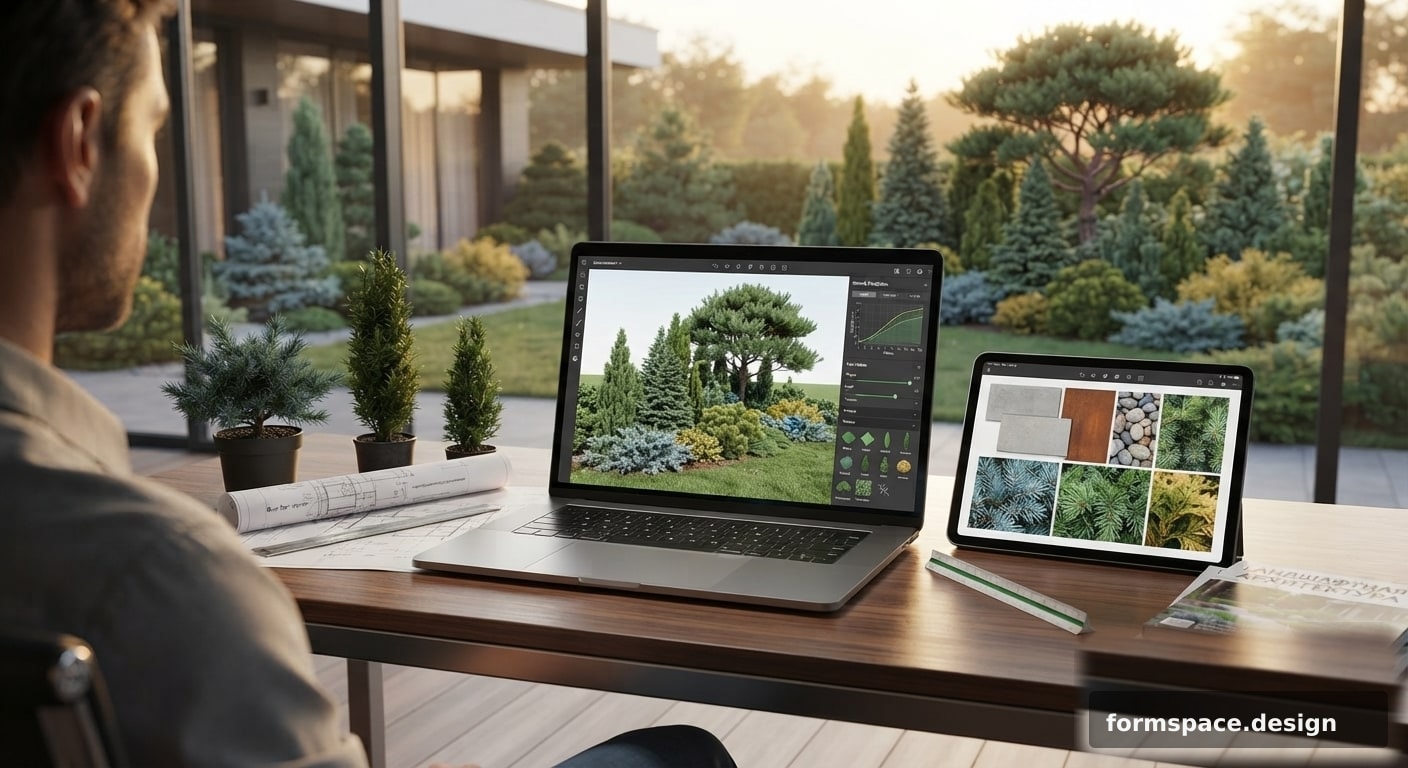
formspace.design est un outil qui vous permet de concrétiser vos idées en un projet concret, même si vous n'êtes pas un professionnel. Commencez par le module 1.1. Plan du terrain. Ici, vous pourrez télécharger un plan cadastral ou simplement dessiner les contours de votre terrain, en indiquant ses dimensions (par exemple, 15x40 mètres pour 6 ares). Ensuite, utilisez le module 1.2. Zones pour une répartition intuitive des zones fonctionnelles : marquez les zones de détente, l'aire de jeux pour enfants, le potager, la zone de service. Cela vous aidera à visualiser comment l'espace sera utilisé et à éviter les erreurs de zonage dont nous avons parlé plus haut. Vous pouvez expérimenter avec l'agencement jusqu'à ce que vous trouviez la solution idéale, correspondant à vos besoins et aux particularités de votre terrain.
Ensuite, passez au module 1.3. Objets pour ajouter les éléments clés : maison, sauna, gazebo, allées, plans d'eau. Si vous souhaitez obtenir de nouvelles idées et concepts, essayez le module 2.1. Concept IA. Téléchargez une photo de votre terrain, indiquez vos préférences, et l'intelligence artificielle vous proposera plusieurs options de design que vous pourrez affiner. Le module 3.1. Design par photo vous aidera à visualiser l'apparence de plantes ou d'éléments décoratifs spécifiques sur votre terrain, simplement en téléchargeant leurs photos. Cette approche permet de voir le résultat futur avant de commencer tout travail, économisant du temps et des dizaines de milliers de roubles qui auraient pu être dépensés pour corriger des erreurs ou payer les services d'un designer.
Questions fréquentes
Est-il possible de concevoir un terrain entièrement seul sans expérience ?
Oui, c'est tout à fait possible. Les outils en ligne modernes, tels que formspace.design, simplifient considérablement ce processus. Ils offrent des interfaces intuitives et des modèles prêts à l'emploi qui aident même les débutants à créer des projets fonctionnels et esthétiques. L'essentiel est d'étudier attentivement votre terrain et vos besoins, puis d'appliquer systématiquement les principes de zonage et de planification.
Combien de temps faut-il pour créer un projet de terrain dans formspace.design ?
Le temps dépend de la complexité du terrain et du niveau de détail du projet. Pour un terrain de taille moyenne (par exemple, 10-12 ares), le zonage de base et le placement des objets clés peuvent prendre de 3 à 5 heures. Si vous souhaitez travailler sur les détails, ajouter de nombreuses plantes et éléments décoratifs, cela peut nécessiter plusieurs soirées. Cependant, comparé aux semaines ou mois de travail avec un designer, c'est très rapide.
Quelle est la précision des dimensions et des distances dans un projet formspace.design ?
formspace.design permet de travailler avec les dimensions réelles du terrain et des objets, ce qui garantit une grande précision. Vous pouvez définir des dimensions spécifiques pour les allées, les parterres de fleurs, les constructions, et contrôler les distances entre les éléments. C'est crucial pour le respect des normes de construction et l'utilisation confortable de l'espace, par exemple pour assurer une largeur de passage d'au moins 80 cm.
Peut-on apporter des modifications au projet après sa création ?
Oui, l'un des principaux avantages de la conception numérique est sa flexibilité. Vous pouvez facilement modifier votre projet dans formspace.design à n'importe quelle étape : déplacer des objets, changer les dimensions des zones, ajouter de nouveaux éléments. Cela permet d'adapter le plan à des idées ou un budget changeants, sans avoir à tout recommencer, ce qui serait impossible avec un dessin sur papier.
Quels sont les principaux avantages de la conception autonome par rapport aux services d'un designer ?
Les principaux avantages sont une économie substantielle et un contrôle total sur le processus. Vous évitez les frais d'honoraires de designer, qui peuvent atteindre des dizaines de milliers de roubles. De plus, vous créez un projet qui reflète entièrement votre vision et vos besoins, sans compromis. C'est aussi une excellente occasion de mieux comprendre votre terrain et de tirer satisfaction du processus créatif.
Que faire si mon terrain est très complexe (forte pente, forme inhabituelle) ?
Même pour les terrains complexes, formspace.design peut être un excellent point de départ. Vous pourrez tracer les contours du terrain, marquer les dénivelés et les caractéristiques existantes. Pour des solutions d'ingénierie spécifiques, telles que le terrassement ou le renforcement des pentes, une consultation d'un spécialiste pourrait être nécessaire. Mais vous pourrez concevoir vous-même le concept général, le zonage et l'emplacement des éléments principaux, économisant ainsi sur la phase initiale de conception.
Commencez à concevoir votre terrain idéal dès aujourd'hui
La conception autonome de votre terrain avec formspace.design n'est pas seulement une économie, mais aussi un processus créatif passionnant. Vous avez la possibilité de créer un espace qui correspondra parfaitement à vos désirs et à vos besoins. Ne reportez pas le rêve de votre jardin idéal — essayez formspace.design et voyez à quel point il est facile et rapide de concrétiser vos idées, même si vous n'avez aucune expérience en aménagement paysager.
Date de publication :

Volodymyr Vybornyi
Paysagiste, fondateur de https://formspace.design/
Écrit sur le design paysager, le business et les outils modernes de conception paysagère assistée par ordinateur, y compris l’IA.